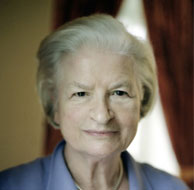
 After 50 years of writing mystery novels, author P.D. James knows a thing or two about crafting a well-written plot. In her new non-fiction book, Talking About Detective Fiction, James discusses the history of the mystery genre and the construct of a good crime novel. “There must be a central mystery,” she explains, “and one that by the end of the book is solved satisfactorily and logically, not by good luck or intuition, but by intelligent deduction from clues honestly if deceptively presented.” James focuses primarily on British authors, and her opinions of some of the genre’s icons are surprising and amusing. Agatha Christie, she posits, “hasn’t in my view had a profound influence on the later development of the detective story.” Though James does offer this backhanded compliment to mystery legend: “Perhaps her greatest strength was that she never overstepped the limits of her talent.” James also prefers Dr. Watson over Sherlock Holmes, finding his character more genuine and relatable, though she does raise some questions about the coziness of their household.
Read more…
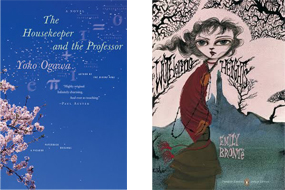 Several blogs have published their lists of the best book cover designs of 2009. Here is a round-up of the standouts: This year, The Book Design Review asked employees of three independent book stores to contribute to their Favorite Covers list. The three part post showcases the selections of staff from WORD in Brooklyn, NY, RiverRun Bookstore in Portsmouth, NH, and The Book Table in Oak Park, IL. The design styles, like the books’ subject matter, vary greatly. But there are some stellar examples of good design, particularly The Housekeeper and the Professor by Yoko Ogawa and Wuthering Heights by Emily Brontë. Readers can vote for their own favorite design in the on-line polls. The Book Cover Archive takes the list one step further with their Top Ten of Covers of the ’00s post. Two covers were chosen to represent each year in the decade, among them, memorable designs for A Shortcut Through Time by George Johnson and The Murder by John Steinbeck.
Read more…
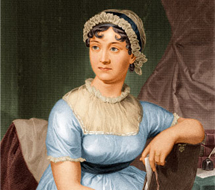 Nearly 200 years after her death, Jane Austen remains one of the world’s best-loved authors. Much has been written about her work and life, and for decades it was widely accepted that she died from Addison’s disease, a rare disorder in which the adrenal gland does not produce enough hormones. However, CNN reports that social scientist Katherine White disputes the diagnosis and theorizes that Austen died of tuberculosis. An article for the British Medical Journal published in 1964, was the first to suggest Austen had Addison’s disease. White, who also suffers from the disease, recently read the article and felt the author’s symptoms did not add up. Sufferers often experience painful headaches and verbal difficulties. But in a letter to a friend written just two months before hear death, Austen states: “My head was always clear, and I had scarcely any pain.” Though this is only anectodal evidence from two centuries ago, endocrinology expert Kenneth Burman agrees there is some merit to White’s theory, due to the wide spread of tuberculosis during the author’s lifetime. Though he warns: “Retrospective diagnosis is very speculative. It’s unknowable with certainty.”
Read more…
 Last year, close friends and business partners, Tom Matlack and James Houghton, engaged in several deep discussions about the true meaning of manhood. From those discussions, The Good Men Project: Real Stories from the Front Lines of Modern Manhood was born. The new book features 31 essays by men from all walks of life, and portrays a wide spectrum of the male experience, from heartbreak to redemption. A 53-minute film documentary, of the same name, has also been released. “We really wanted to spark a national conversation on what it means to be a man, and to help the 30 million boys and girls in our country who don’t have a father,” states Tom Matlack in an interview with L.A. Times’ Jacket Copy. The goal for this project is to help men realize they are not alone. Many feel they have to struggle with emotional issues and societal pressures in silence. Matlack and Houghton hope the men’s real-life stories will be relatable in a non-threatening way. “By getting to know them and reading their stories, I’m better for it. Our hope is that the people who read the book feel the same way,” explains Matlack.
Read more…

New York Public Library logos old (left) and new (right).
The New York Public Library has updated its brand identity for the digital age. The new logo, a bolder more streamlined version of a lion profile inside a circle, is designed to work both on-line and in print. The simple shapes and smooth curves, along with a new color pallet, allow the mark to be used in a variety of sizes and resolutions without losing any detail. Kievit, a new sans-serif typeface, was chosen to compliment the logo with its contemporary look. The re-design, the first in over 25 years, was done in-house by the library’s creative team, and is based on the stone lions that adorn the main library steps. “It’s primarily based on Fortitude [the northern lion], but it’s a combination of both,” explains Marc Blaustein, art director for the library system. “The angle is Fortitude, but some of the features are inspired by Patience.”
Read more…
 Seventy-one years after a 16th century Rabbinic Bible was looted in a Nazi raid, it was finally returned to its rightful home in Vienna’s Jewish community. Published during 1516-1517, the Bible contains landmark treatises by leading rabbinical figures of the medieval period, such as 11th century French scholar Rashi and 13th century Spanish scholar Nachmanides. The two-volume Bomberg/Pratensis Rabbinic Bible was part of the rare book collection in the Israelitische Kultusgemeinde Wien (IKG) library seized in Austria on Nov. 9, 1938, during the infamous Kristallnacht (Crystal Night). Over the next four years, large portions of the IKG library were parceled out to Nazi outposts in Poland, Lower Silesia and North Bohemia (Czech Republic). The Bible didn’t resurface again until June 25, 2009, when the New York-based auction house Kestenbaum & Company listed the item in its catalog. An investigation by U.S. Immigration and Customs Enforcement (ICE) revealed that the ancient volumes were the rightful property of the IKG library, and had been imported into the U.S. illegally on March 19, 2009. When the investigating agents submitted proof of the Bible’s true ownership to Kestenbaum, the auction house promptly removed the item from auction and agreed to return it to the rightful owners.
Read more…
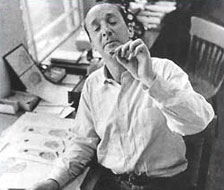 Vladimir Nabokov’s last work has finally been published by his son, Dmitri, and the book received a cool reception from some corners of the literary world. Nabokov was working on The Original of Laura just prior to his death in 1977, and though some regard its publishing as an unearthing of a literary treasure, others feel it is a violation of a dying man’s last wish. Before his passing, the author requested that his wife, Vera, burn the collection of 138 index cards that held all his notes for the book. After his death, Vera could not bear to destroy the work, and stored the cards in a Swiss bank vault. This was not the first time she had prevented Nabokov’s work from being destroyed; she previously stopped him from burning the manuscript of his seminal work Lolita. The notes remained locked away for decades, even after Vera’s death in 1991, until their son, Dmitri, recently decided to publish them. Further eyebrows were raised when, Dmitri, released a 5,000-word excerpt to Playboy magazine, though he defended his choice by explaining his father’s fondness for the publication’s cartoons.
Read more…

Last week, Best-selling author James Patterson made a special appearance at the ALA’s American Association of School Librarians national conference, held in Charlotte, North Carolina. In his speech, he called for all librarians to fight hard to get more kids hooked on reading. “It’s time for librarians to start making a lot more noise,” Patterson urged. “School libraries are not a luxury, they are a necessity. … When you turn kids on to reading, it is the most satisfying thing that you can do on the planet.” The writer’s passion for literacy has inspired him to create a new website, ReadKiddoRead.com, that assists librarians, educators and parents in finding quality books for children. The site, aimed at kids of all ages, reading and interest levels, features book recommendations, reviews and Patterson’s interviews with prominent authors.
Read more…
 The American Library Association (ALA) and Safeway Inc. have teamed up to bring information about libraries to households nationwide. The partners have planned a campaign of five Safeway-brand cereal boxes with back panels detailing interesting facts about libraries and librarians. The first two boxes were released in October, and the remaining boxes will be released in a staggered schedule over the next few months. Honey Nut Toasted Oats and Toasted Oats boxes featuring the library panels are in stores now, and are available in Safeway’s 1,500 locations nationwide. This partnership provides a great platform for the ALA to emphasize the relevancy and importance of libraries, even in today’s digital age. “The cereal boxes will bring information about some of the exciting ways to enjoy libraries – and about the value of libraries – straight into people’s homes,” said ALA Executive Director Keith Michael Fiels.
Read more…
 An unwanted copy editor has been digging through the stacks of The Maury County Public Library in Columbia, Tennessee. The local News Channel 5 reports that library staff has found over 50 books with profane language crossed out in blue ink. The targeted books are mostly fiction, many of them mystery novels, though the 9/11 Commission Report was also defaced. “It’s one word, in particular. It’s the ‘f’ word,” says Library Director Elizabeth Potts. But, catching the culprit will be very difficult. Due to a federal law that protects library patrons’ privacy, no records are kept to track the history of who borrowed a book. If caught, the offender could be charged with vandalism, or face more serious charges if they have caused more than $500 in damages. Though Potts isn’t planning to prosecute, she does want the illegal copy editing to stop. The stealth censor is violating Free Speech and altering the authors’ creative vision.
Read more…