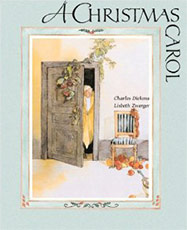
 Which book would you most like to pass on to your children? This was the question posed by Britian’s University of Worcester, querying 2,000 adults about the singular book they would choose to share with their kids. Being a British poll, native authors were heavily favored in the top ten list, with Charles Dickens’ A Christmas Carol taking the number one spot. The only Americans to make the list were George Orwell, who came in at number seven with Animal Farm and Harper Lee, who earned the tenth spot with her only novel To Kill a Mockingbird.
The premise of the poll, choosing only one book, is a bit unfair, as most book lovers would be hard pressed to chose just a single book to pass on to their children. No doubt a list as subjective as this will have many bibliophiles shaking their heads at the titles that were not included. For my part, I would have included at least one Roald Dahl title, James and the Giant Peach and Charlie and the Chocolate Factory come quickly to mind. I also feel that J.D. Salinger’s Catcher in the Rye deserves a spot, as Holden Caulfield, that paragon of adolescent discontent, has left an indelible imprint on contemporary literature. Read more…
Categories: Classic, Fiction, News, Young Adult Tags: book news, Charles Dickens, Classic, Fiction, George Orwell, Harper Lee, J.D. Salinger, Roald Dahl, young adult
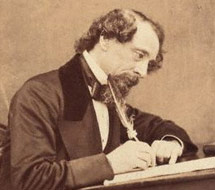 Readers around the world are commemorating the 200th birthday of beloved author Charles Dickens today. Among the numerous events planned is a Global Dickens read-a-thon launched this morning by the British Council. At the top of each hour, a new video of a Dickens reading is posted on the Council’s Twitter feed (@BritishCouncil). The posted readings are chosen from submissions worldwide. According to the British Council’s website “Each exclusive clip will reflect on the most interesting, engaging and significant moments in Dickens’ literary colossus.” Read more…
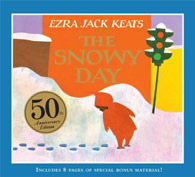 The Snowy Day, the Caldecott Medal winning picture book by Ezra Jack Keats, celebrates its 50th anniversary this year. The story depicts the explorations of a young boy named Peter, who wanders about his neighborhood after a fresh snowfall. The book broke new ground by featuring an African-American boy as the main character, charmingly drawn in an iconic red snow suit. The child’s race is never referenced in the text. “It wasn’t important. It wasn’t the point,” explained Deborah Pope, the executive director of the Ezra Jack Keats Foundation, on NPR’s All Things Considered program. “The point is that this is a beautiful book about a child’s encounter with snow, and the wonder of it.” Read more…
 This week The Huffington Post recounted the true, but little known, story of the inspiration behind Charles Dickens’ iconic holiday tale A Christmas Carol. Though the British author had already published several novels, he was struggling to make ends meet in the fall of 1843. During an evening constitutional through a seedy London neighborhood, Dickens was reminded of his own hardscrabble childhood, and was struck with the inspiration to write a cheerful, uplifting Christmas story for all those who had felt the harsh sting of poverty.
With the holidays quickly approaching, he decided on a short story format, and gave the publisher very detailed instructions on the book design, specifying a gold stamped cover, a green and red title page and several etched illustrations. Despite the high production values, the book was reasonably priced at five shillings, so that it would be affordable to a large segment of the population. Read more…
 If any of you are looking for a scary tale to settle down with after all the little candy goblins have slipped dreamily into a sugar coma, try the classic blood-sucking tale Dracula by Bram Stoker. A recent AP article sings the praises of the archetypal vampire, comparing him favorably to the contemporary literary vampires of the angst-y teen heartthrob and tragic Southern gentlemen varieties. “Vampires have become too soft, too lovelorn, too nice. There’s no good side to the original Count Dracula. He’s evil, plain and simple.”
“From the first pages of the 1897 novel, with all those villagers watching solicitor Jonathan Harker make his way to the Count’s castle in Transylvania, the book draws you in…Dracula is surprisingly easy to read, and I highly recommend its company while waiting for trick or treaters.” Read more…
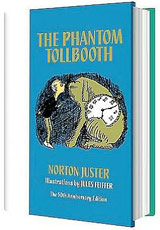 As beloved children’s book, The Phantom Tollbooth, turns 50 years old, author Norton Juster reflects on the book’s creation in a guest article for NPR. The idea for his debut book, which tells the story of a young, restless boy named Milo who discovers a mysterious toll booth and embarks on adventures in the Lands Beyond, came to Juster in a round about way.
“Like most good things that have happened in my life, The Phantom Tollbooth came about because I was trying to avoid doing something else. It was 1958, and after three years in the Navy I returned to New York City to work as an architect. I had also received a grant to do a book on cities for children. I started with great energy and enthusiasm until I found myself waist-deep in stacks of 3-by-5 note cards, exhausted and dispirited. This is not what I wanted to do.” Read more…
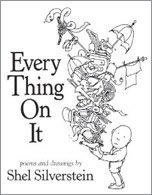 There are millions of adults out there who were obsessed with Shel Silverstein’s poems in Where the Sidewalk Ends and A Light in the Attic at some point during their childhood. What kid could resist that magical blend of humor and storytelling accompanied by the author’s quirky illustrations? Now a new generation of children can enjoy a brand new book by Silverstein, and become entranced by his lyrical wit. This week, HarperCollins released Every Thing On It, a compilation of poetry and artwork that has never been published before. Though the writer passed away in 1999, this posthumous publication is not a tossed together collection of his lesser work. According to an article in the Los Angeles Times, the book “was culled from material Silverstein really liked but never found a place for in his other collections.” Read more…
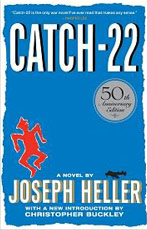 Catch-22, Joseph Heller’s classic satire on the absurdity of war will turn 50 this October, and publisher Simon & Schuster has released a special anniversary edition of the book to commemorate the occasion. This latest edition features a bounty of additional material including a new introduction written by Christopher Buckley, several essays by Heller discussing the conception of the story, and critical reviews by literary luminaries such as Anthony Burgess and Norman Mailer. The writer served in World War II, and his personal experience helped shaped the story of Yossarian, the hapless bombardier forced to risk his life by flying an increasing number of missions for the good of his country. Catch-22, the convoluted bureaucratic rule that prevents Yossarian from escaping combat is now embedded in our culture as part of the English vernacular. Read more…
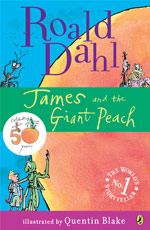 This year marks the 50th anniversary of Roald Dahl’s classic James and the Giant Peach, which according to the author’s website, was the “first major book” Dahl wrote for children. Generations have fallen in love with the orphan James Henry Trotter, forced to live with his horrible aunts, Sponge and Spiker, who embarks on a magical adventure inside a giant peach. To celebrate the silver anniversary, publisher Penguin has created an interactive global campaign called Follow that Peach! Children, parents and people of all ages are invited to send Peach-grams to friends and family worldwide to share the news of the book’s birthday. Read more…
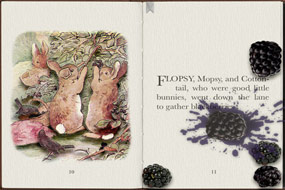
Mashable names "PopOut! The Tale of Peter Rabbit" as one of the top interactive children's books for the iPad.
In previous posts, In the Stax has discussed the merits of the iPad as an eReader and as an educational tool for young children. This engaging device also offers a unique platform for app developers to combine these two functions and produce stand-out interactive interpretations of classic children’s stories. Mashable recently posted a list of their Top 5 classic children’s books designed for the iPad. Each selection was chosen for the eBook’s ability to engage young readers and provide a variety of interactive experiences through out the story. Read more…